The cost of owning a ski chalet in Slovakia comes in two parts that behave very differently. Buying is light on fees, because Slovakia has had no real estate transfer tax since 2005: on an illustrative €400,000 purchase, the cadastre fee and the notary's escrow fee come to just under €1,000. Keeping the house is where the money goes, and local taxes are the smallest part of it. Energy, insurance, maintenance, winter care and, if you rent, management and cleaning decide the real monthly figure.
This guide goes through each cost, shows how it is calculated and gives the legal source and date for every fixed number. Where a cost depends on the house and how you use it, we show you how to work it out rather than print an average that would not fit your house. All figures are valid on 3 October 2026. For the buying process itself, see our guide to buying a ski chalet in Slovakia.
What does it cost to buy a ski chalet in Slovakia?
| Cost | Amount | Basis |
|---|---|---|
| Real estate transfer tax | None since 2005 | Act No. 554/2003 Coll., § 18 |
| VAT on a new house from a VAT-registered developer | 23%, included in the price | Act No. 222/2004 Coll., § 27 and § 38 |
| Cadastre fee (návrh na vklad) | €100 on paper, €50 electronically, per legal act | Act No. 145/1995 Coll., item 11, since 1 January 2025 |
| Expedited decision within 15 days | €300 on paper, €150 electronically | Same |
| Registration of a mortgage pledge | A second cadastre fee, as a separate legal act | Same |
| Notary escrow (notárska úschova) | Sliding tariff, see below | Decree No. 31/1993 Coll., annex from 17 August 2026 |
| Notarial signature verification | €4 per signature, €8 for use abroad, plus VAT | Same decree |
| Lawyer, translations, valuation, currency transfer | By agreement or quote | Ask for fixed quotes |
The notary's escrow fee is a sliding scale on the amount held. On illustrative prices, not NOVALY prices, it is €725 plus VAT on €400,000, €875 plus VAT on €600,000 and €975 plus VAT on €800,000. With 23% VAT, where the notary is a VAT payer, that makes €891.75, €1,076.25 and €1,199.25.
There is no reduced VAT rate for private housing in Slovakia, so a new house from a VAT-registered developer carries 23% VAT in its price. A resale house from a private owner who is not registered for VAT carries none, and a VAT-registered seller's sale of a building is exempt once five years have passed since the occupancy approval that allowed its first use (VAT Act, § 38(1)). If you finance the purchase with a Slovak mortgage, our guide to financing a mountain home in Slovakia explains the lending limits.
Does Slovakia have property tax?
Yes. Property tax (daň z nehnuteľností) is a local tax: the Local Taxes Act (Act No. 582/2004 Coll.) sets the rules, and each municipality sets its rates by ordinance (VZN). Four rules shape your bill:
- Who pays and when: the owner on 1 January. The liability arises on 1 January of the year after you acquire the property, and the return is due by 31 January of that year (§ 18, § 99a). Buy in 2026, file by 31 January 2027.
- The base is the footprint, not the floor area: for a building it is the built-up area (zastavaná plocha), measured at the level of the largest above-ground part, without roof overhangs (§ 11). Each further above-ground floor adds a surcharge (§ 12).
- The category follows the actual use on 1 January: residential, recreational or business (§ 10). Mixed use is split by floor area.
- Land under the building is not taxed twice: the rest of the plot is taxed according to its land type (§ 6 and § 7).
How much property tax does a chalet in Donovaly pay?
The Donovaly ordinance VZN 2/2023, which the municipality's website cites for property tax, sets these annual rates:
| Object | Annual rate in Donovaly |
|---|---|
| Residential buildings, chalets and buildings for individual recreation | €1.65 per m² of built-up area |
| Buildings used for other business and gainful activity | €1.95 per m² of built-up area |
| Each further floor above the first above-ground floor | €0.33 per m² |
| Land: built-up areas and courtyards | 5% of a value of €1.32 per m² |
| Land: gardens | 1% of a value of €1.32 per m² |
Illustrative example (a hypothetical chalet, not a specific property): a footprint of 130 m² on two above-ground floors pays 130 × €1.65 = €214.50, plus 130 × €0.33 = €42.90, so €257.40 a year, or €21.45 a month. Classified as a business building, it would pay €296.40. If 600 m² of the plot is registered as built-up area and courtyard, the land adds €39.60 a year; as a garden, €7.92.
One caveat: Donovaly adopted a newer local tax ordinance (VZN 2/2024), in force since 1 January 2025, whose full text is not published online. Ask the municipality to confirm the property tax rates for the current year. Under the 2023 ordinance, an individual pays in two instalments, or in one if the tax does not exceed €100.
The same ordinance sets the municipal waste fee: €35 a year per property for owners without quantity-based collection, and €35 per bed per year for those who provide accommodation. Confirm the current amounts with the municipality too.
How do you price insurance and energy?
These two costs set most of your monthly figure, and they depend on the house and how you use it. A premium or a bill that fits a small cottage says nothing about a large chalet with a sauna, so here is how to price them for the house you are considering.
Insurance
Slovak law does not make building insurance compulsory, but a lender may require appropriate insurance and must accept an equivalent policy from another insurer (Act No. 90/2016 Coll., § 4). In practice, banks ask for building insurance with the claim assigned to the bank (vinkulácia). Non-life insurance carries a 10% insurance tax for insurance periods starting on or after 1 January 2026, up from 8% (Act No. 213/2018 Coll., as amended by Act No. 261/2025 Coll.). The premium depends on the rebuild value, the location and natural hazards such as snow load and storms, the contents, the liability limit and the excess (deductible). Tell the insurer if you let the house to guests, and compare at least two quotes.
Energy and utilities
Your energy cost depends on the energy standard of the building, the heating system, the altitude and exposure, the temperature you keep while the house is empty, how many people use hot water, and equipment such as a sauna. Start from the energy performance certificate, which a seller must hand over to the buyer (Act No. 555/2005 Coll., § 8):
- Take the calculated energy need per m² per year from the certificate and multiply it by the floor area.
- Multiply the result by your supplier's tariff for the energy source the house uses.
- Add what the certificate does not model, such as appliances, a sauna, wellness equipment and outdoor lighting.
- Add the standing charges for electricity, water and sewage, internet and, if connected, gas.
Illustrative arithmetic: a 200 m² house with a calculated need of 60 kWh per m² a year needs about 12,000 kWh a year for the uses the certificate covers. Multiply that by your own tariff; energy prices change too often to print here.
What should you set aside for maintenance and winter care?
A mountain house works harder than a town house. Snow, ice, strong sun and moisture wear out exterior timber, roofs, gutters, seals and paving faster. A new build starts with fewer repairs, and defects must be notified to the seller without undue delay, at the latest within 24 months of handover (Civil Code, Act No. 40/1964 Coll., § 599); an older chalet needs a larger reserve from day one.
Rather than a rule-of-thumb percentage, build a sinking fund. List the big items (roof, cladding finish, windows, heating system, sauna and wellness equipment), estimate the replacement cost and lifespan of each, and set aside the cost divided by the lifespan every year. Add routine servicing of the heating system and any flues.
In winter someone also has to keep the driveway open, sometimes daily, and check the house when it stands empty. Ask who clears the access road (the municipality, a private association or you), get quotes from local services for the driveway, and budget for a caretaker who checks the heating, the pipes and the snow on the roof after storms.
What extra costs come with renting it out?
Letting the chalet adds costs that rise with every stay:
- Management: guest communication, key handover, check-in and problem-solving, usually priced as a share of rental income.
- Cleaning and linen after every stay, plus consumables and faster wear of furniture and equipment.
- Platform commission on each booking.
- Accommodation tax: in Donovaly €2 per person per night since 1 January 2025, collected from guests or, if you opt for it, a flat €40 per bed per calendar year (VZN 2/2024; Act No. 582/2004 Coll., § 41d). Eight guests staying three nights pay €48.
- Waste fee per bed instead of per property, as above.
- Insurance that covers paying guests.
- Income tax on the profit and, for foreign owners, possibly 5% VAT from the first booking.
All the rental rules, including the short-term rental register (called eTurista in Slovak media) that starts on 1 January 2027, are in our guide to Slovakia's short-term rental rules and taxes. If you are weighing rental income against these costs, read our guide on whether a ski chalet is a good investment next.
What does owning a ski chalet cost per month?
Most buyers think in monthly terms, so here is a budget template. The public charges are filled in for the illustrative chalet above; you fill in the rest from quotes.
| Item | Per year | Per month | Source |
|---|---|---|---|
| Building tax (130 m², two above-ground floors) | €257.40 | €21.45 | Donovaly VZN 2/2023, confirm |
| Land tax (600 m² of built-up area and courtyard) | €39.60 | €3.30 | Act No. 582/2004 Coll., VZN 2/2023 |
| Waste fee (owner, no rental) | €35.00 | €2.92 | Donovaly VZN 2/2023, confirm |
| Fixed public charges | €332.00 | €27.67 | |
| Insurance, including 10% tax | Your quote | Quote ÷ 12 | Insurers |
| Energy and utilities | kWh × tariff, plus standing charges | Total ÷ 12 | Certificate, suppliers |
| Maintenance reserve | Replacement cost ÷ lifespan, per item | Total ÷ 12 | Your plan |
| Snow clearing and caretaker | Quotes | Total ÷ 12 | Local services |
The table makes one point clearly: in Slovakia the state and the municipality take little each year. Your monthly cost is mostly what you spend on energy, care and services, which is why the energy standard and build quality of the house matter more than the tax rate.
What does it cost when you sell?
Income from selling a property is exempt from Slovak income tax once five years have passed since you acquired it (Act No. 595/2003 Coll., § 9(1)(a)). Watch two traps: money received under a future sale contract concluded within those five years is not exempt, even if the final contract is signed later; and if the chalet was a business asset, the five years run from its removal from the business. If you sell earlier, the gain is taxed at the progressive rates of 19% to 35% that apply from 2026. Your home country may tax the gain as well, so ask a tax adviser in your country before you plan a sale.
Summary
- Slovakia has no real estate transfer tax; on an illustrative €400,000 purchase the cadastre fee and notary escrow come to just under €1,000, plus legal and translation fees.
- A new house from a VAT-registered developer includes 23% VAT in the price, with no reduced rate for private housing.
- Property tax is based on the footprint; in the Donovaly example it is €257.40 a year for the building, about €28 a month with land tax and the waste fee.
- Insurance, energy, maintenance and winter care decide your monthly cost; price them from quotes and the energy certificate.
- Renting adds management, cleaning, accommodation tax and possibly VAT; selling after five years is free of Slovak income tax.
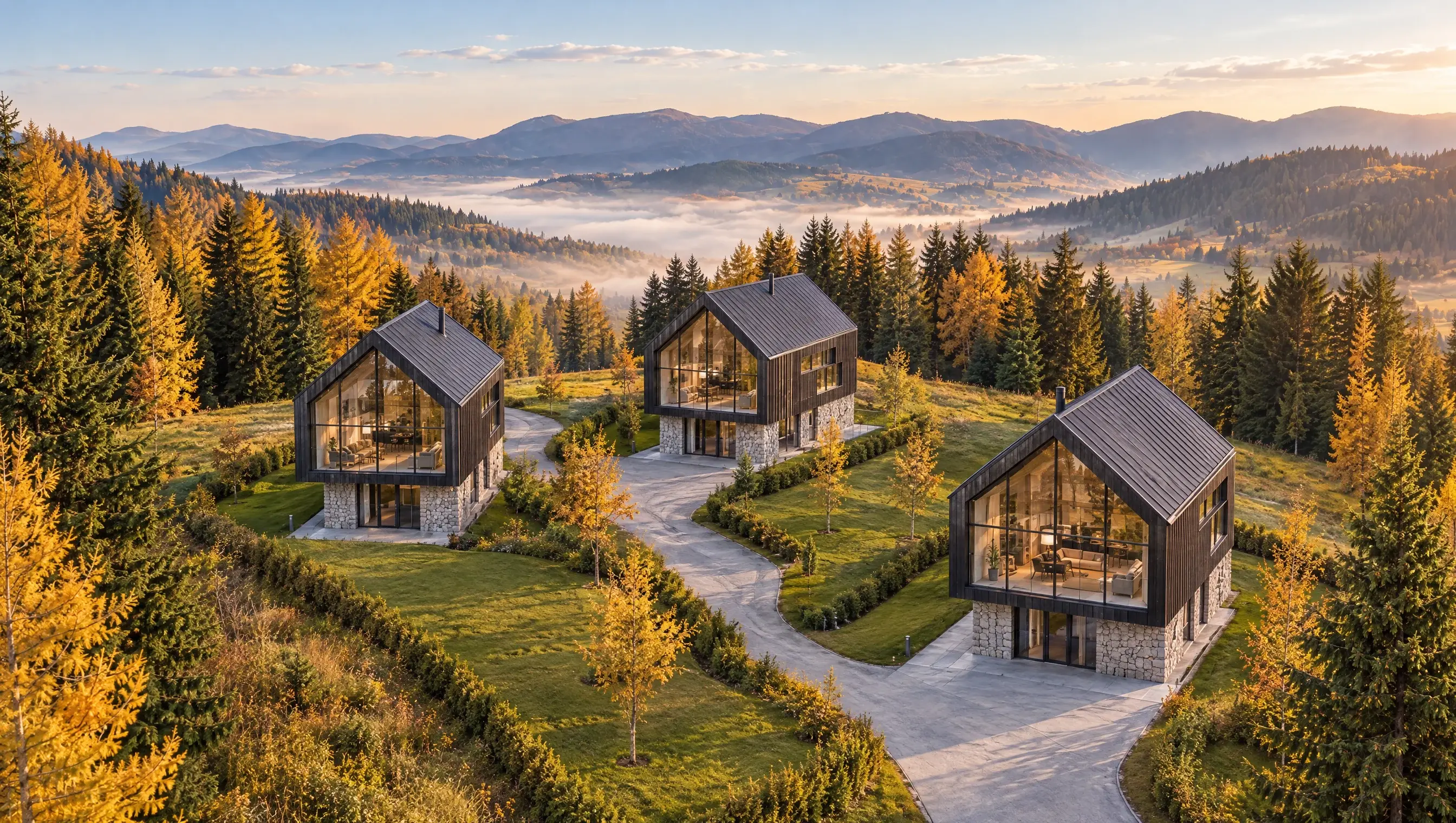
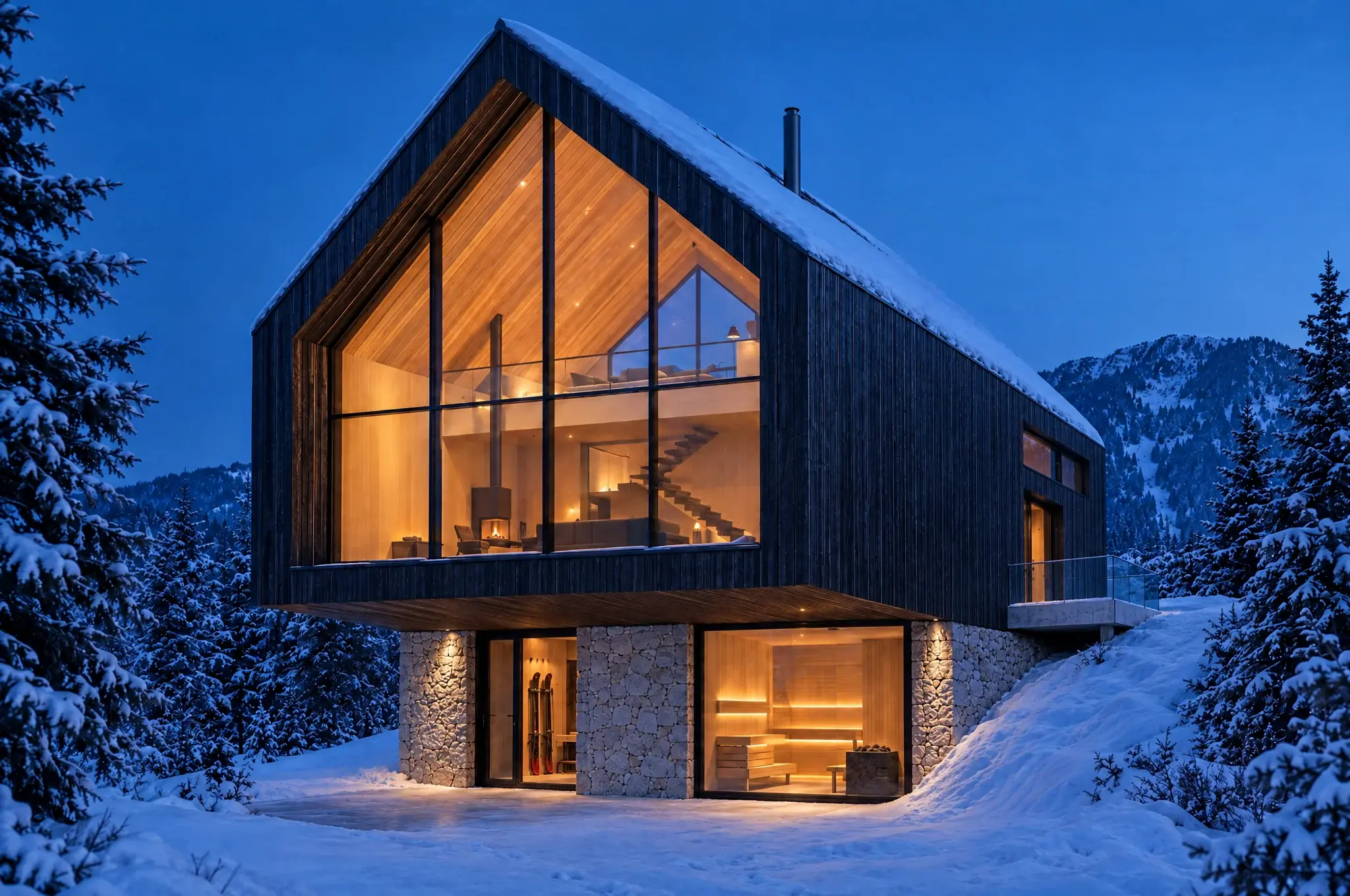
Running costs are decided mostly by the house itself: its footprint, its energy standard and how you use it. When you compare NOVALY's six chalets in Donovaly with other options, bring this template to a viewing and ask us the questions behind each line; floor plans and current availability are on the chalets page.